
Outdoor Patios Planned Around Marshfield’s Water and Wetlands
A homeowner in Brant Rock might picture a patio a few steps from the seawall, while a homeowner off Route 139 is working with a bigger, shadier lot farther inland. Both are common starting points in Marshfield, and both come with the same first question: how close is this yard to a wetland, marsh, or the coast, and what does that mean for what can get built?
Marshfield’s own Wetlands Protection Bylaw (Chapter 294) goes further than the state Wetlands Protection Act. It requires Conservation Commission review for work within 100 feet of a wetland, marsh, pond, or coastal bank, and within 200 feet of a river with year-round flow. Marshfield also applies a 75-foot no-disturb setback inside that 100-foot buffer, stricter than the 25 or 50 feet used in many South Shore towns. Given how much of town runs along the North River, the South River, the Green Harbor River, or the coastline itself, this review comes up often, not just for waterfront lots. An outdoor patio in Marshfield needs a plan that accounts for the review from the start, before anyone picks out a design.
JRD Landscape Design starts each Marshfield patio project with a site walk to identify anything that falls inside a wetland resource area or its buffer zone. Knowing where those lines fall before design starts is what keeps a project moving.
Talk Through Your Marshfield Patio Project
The distance between your back door and the nearest wetland line decides more about this project than any material choice will. We can tell you where that line falls on your lot and what it opens up.
What an Outdoor Patio Involves on a Marshfield Lot
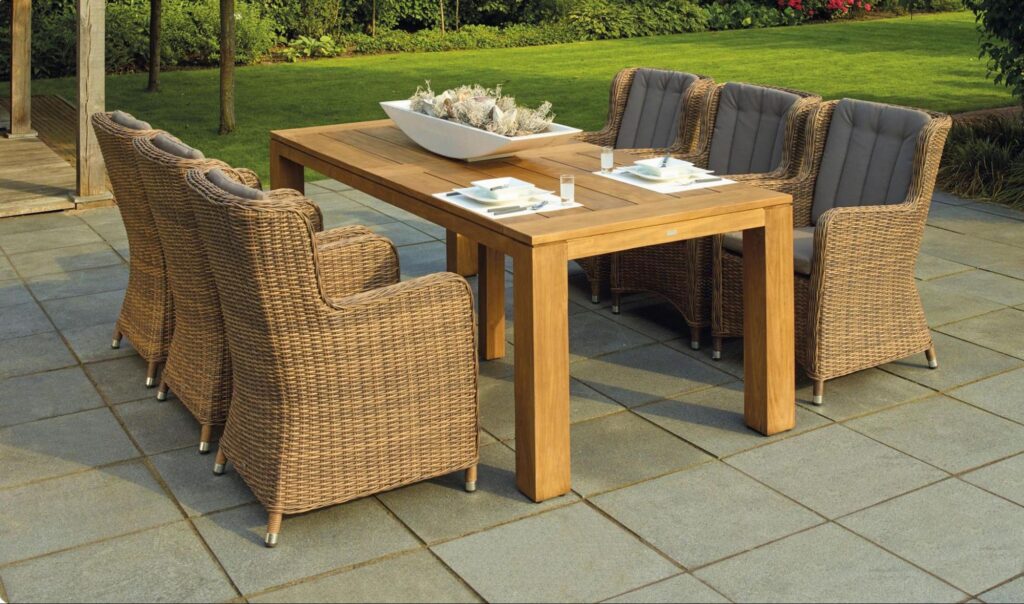
A patio is the one part of a yard that gets used without anyone planning to use it. It is a ground-level surface of pavers, stone, or concrete over a compacted base, and on the coast the base does more work than the surface ever will.
A well-built patio gives you more space to enjoy the outdoors, whether you are sitting, cooking, or gathering with friends and family. What changes from lot to lot is the site work underneath, which is where our outdoor patio design and construction work starts on every Marshfield project.
What We Build Into a Marshfield Patio
What goes into a Marshfield patio depends on how close the lot sits to the water. A yard three streets back from the beach and a yard on the marsh edge call for different surfaces, different materials, and a different approach to wind and drainage. JRD Landscape Design works through those choices with you before anything gets drawn.
Permeable Paver Patios: On a lot inside the wetland buffer, a permeable surface lets rain soak through instead of sheeting off, which affects both how much of your yard counts as impervious and how the Conservation Commission looks at the plan.
Standard Paver Patios: Individual units can be lifted and reset if a section ever settles, so a repair stays local instead of turning into a full rebuild.
Natural Stone Patios: Granite and dense bluestone stand up to salt air better than softer, more porous stone, which matters within a few streets of the water.
Stamped Concrete Patios: A lower-cost way to get a stone or brick look, though a poured slab is more prone to surface scaling where salt spray and freeze-thaw meet.
Fire Pits and Seating Areas: The evening breeze off the water cools a Marshfield yard earlier than an inland one, and a fire pit is what keeps people outside through September and October.
Seat Walls and Wind Screens: Low walls and planted screens cut the onshore wind without closing off the view toward the marsh or the water.
Stone Walkways: A defined path from the patio back to the door keeps beach sand where it belongs and gives the yard a clear route between spaces.
Outdoor Kitchen Tie-Ins: Cooking and prep space built into the patio, with stainless hardware specified for salt exposure.
Few of these get built on their own. When the patio, the walkway, and the seating are drawn on one plan, the materials and the sightlines line up and the yard reads as a single space. Added one at a time over a few seasons, they usually do not.
Get a Plan for Your Property
Permitting and Site Prep for a Marshfield Patio
Getting a patio right in Marshfield comes down to a handful of site-specific factors: the wetland buffer, the soil, the materials, and whatever is already built into the shoreline.
Wetland Buffer Zone Review
When a lot falls inside the buffer zones described above, Marshfield’s Conservation Commission has to review the project before construction starts. Smaller projects are usually eligible for a Request for Determination of Applicability, while more involved site work may require a full Notice of Intent. We identify which filing applies during the property walk-through, so the paperwork starts on the same day the design does.
Soil and Drainage Planning
Sandy, well-draining soil is common in Marshfield’s coastal neighborhoods, and that works in a patio’s favor. Granular soil lets water move through instead of holding it, so there is less for frost to push on over the winter. The soils that cause trouble in a freeze-thaw climate are the silt and clay-heavy ones found on some lots farther inland, which trap water and heave. Those are the lots that need a deeper base and a separation fabric under the aggregate. We check the soil during the site walk so the base is built for what is actually there instead of a standard spec.
Material Selection for Coastal Exposure
Homes closer to the water deal with more salt air and wind-driven rain than inland properties, and salt is hard on masonry. Chloride exposure combined with freeze and thaw is what causes surface scaling, spalling, and efflorescence on porous pavers. For patios in the beach neighborhoods we specify dense, low-absorption pavers or salt-tolerant stone like granite and dense bluestone, rather than defaulting to an inland spec. Where a project adds a pergola, an outdoor kitchen, or railings, the hardware moves to stainless or hot-dip galvanized. It is a small decision at the design stage that matters more once the patio has been through a few Marshfield winters.
Grading Around Existing Shoreline Structures
Many coastal Marshfield properties already have a seawall, retaining wall, or existing drainage system in place, and a new patio has to work with those rather than against them. We grade the site so water moves away from the house and off the patio surface without redirecting it onto a neighboring property or into a protected wetland area. This step often shapes the layout more than the style of stone or paver selected.
Every one of these factors can be worked out ahead of time. That planning is where JRD Landscape Design spends most of its time on a coastal project, so the build itself moves quickly once it starts.
Why Marshfield Homeowners Choose JRD Landscape Design
Marshfield properties range from tight coastal lots to larger inland parcels, and our team treats each one as its own project rather than a repeat of the last.
On the coast, the layout question comes before the material question. We look at where the wind comes from, which corner still gets sun at six in the evening, and what the yard looks at, whether that is open water, the marsh, or a line of trees. A patio angled a few degrees differently, or set two feet closer to the house, can be the difference between a space the family uses every night and one that gets used twice a summer. Those decisions get made on paper, while they are still easy to change.
JRD designs and builds every project in-house, so the team that plans your patio is the team that installs it. There is no handoff between a design firm and an outside crew. We also keep homeowners in the loop at each phase, from the first wetland buffer check through final grading, so nothing about the timeline or the site work comes as a surprise partway through.
That clarity matters most on a lot where the Conservation Commission is involved. The biggest source of delay there is usually a missed step in the paperwork, not the construction.
What Marshfield Homeowners Are Saying
⭐⭐⭐⭐⭐
“Jose and team did an amazing job on a large backyard project.”
Ron R., Verified Customer
⭐⭐⭐⭐⭐
“We’ve used Jose and JRD Landscape multiple times and they’re consistently great. Jose is easy to work with, always on time, and delivers high-quality results. Highly recommend!”
Peter C., Verified Customer
Put the Space to Use
Where We Build Patios Across Marshfield
JRD Landscape Design builds outdoor patios throughout Marshfield, including Marshfield Hills, Ocean Bluff-Brant Rock, Fieldston, and the Green Harbor and Rexhame areas along the coast, as part of the full range of outdoor living services we offer across Marshfield.
Much of the town borders water. The North River runs along the Scituate line, the South River splits off the Rexhame peninsula, and the Green Harbor River sits near Brant Rock. In town, the Daniel Webster Wildlife Sanctuary and the North River Wildlife Sanctuary mark the kind of protected wetland acreage that shapes so many projects here.
Our work also extends into the towns Marshfield borders, including Duxbury, Pembroke, Norwell, and Scituate.
Marshfield, MA Outdoor Patio FAQs
How much does an outdoor patio cost in Marshfield?
Patio costs on the South Shore generally run $25 to $50 per square foot installed. Stamped concrete sits at the low end, concrete pavers in the middle, and natural stone like bluestone at the top. Site conditions often move that number more than material does, since grading, drainage, and Conservation Commission requirements on a coastal lot can add more than switching materials would.
What’s the difference between a patio and a raised deck?
A patio sits at ground level with no structural attachment to the home. A raised deck attaches to the house and sits above grade. On Marshfield’s coastal lots, many homes are already elevated to meet flood zone requirements, which makes an attached deck a natural companion to a ground-level patio rather than a replacement for it.
How long does Conservation Commission review take for a patio project in Marshfield?
Most patio filings clear in about six to eight weeks. The Conservation Commission opens a public hearing within 21 days of a complete filing, issues its decision within 21 days of the hearing closing, and a 10-day appeal period follows. A Request for Determination of Applicability usually moves through in a few weeks. A Notice of Intent takes longer, since the hearing can be continued across several meetings. The Conservation Commission’s page lists current filing requirements.
How should homeowners near the coast maintain a patio over time?
Rinse the patio with fresh water every month or so to clear salt spray and sand before it builds up. Beyond that, pavers and natural stone need little upkeep. Top off the joint sand every two to three years and reseal the surface every three to five. That keeps the pavers locked together and keeps weeds and ants out of the joints. The base itself stays put because of proper compaction and edge restraints, not the sand.
When’s the best time to start a patio project in Marshfield?
Spring through fall is the standard building season, though design and material selection can start any time of year. Starting the conversation early, especially if the Conservation Commission needs to review the project, helps avoid delays once the season is underway.
Ready to Start Your Marshfield Patio?
A Marshfield patio project comes together fastest when the wetland review, the site work, and the design are handled in the right order rather than worked out along the way. Our team manages each of those phases directly, start to finish, so nothing gets left for you to coordinate. Get in touch to start planning your Marshfield patio.